
SD-WAN vs SASE: A Practical Decision Framework for Australian Mid-Market Organisations
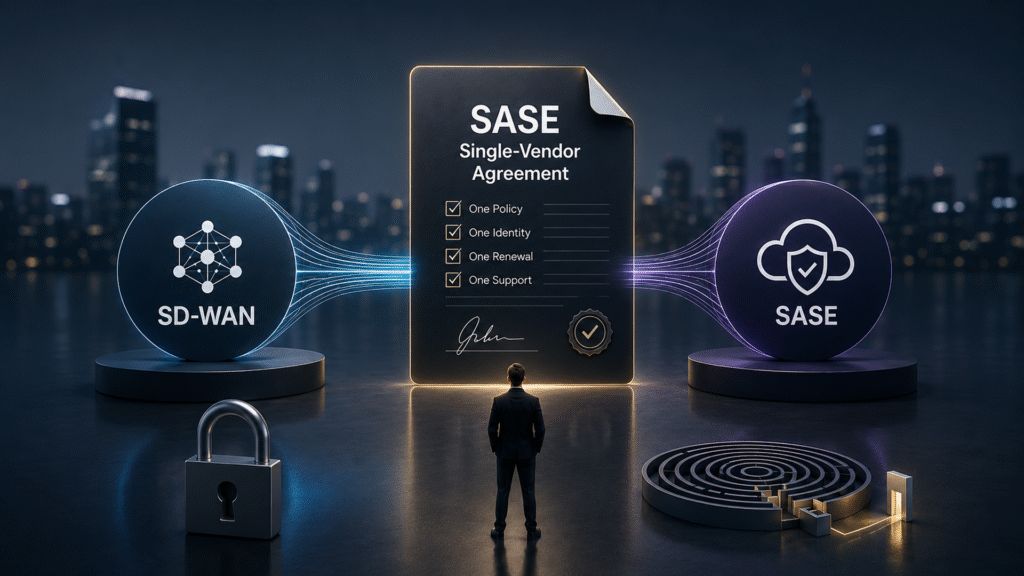
Gartner now expects 60 percent of new SD-WAN purchases in 2026 to be part of a single-vendor SASE deal. That number is not a prediction. It is a description of what procurement teams are already doing.
For Australian mid-market IT leaders, this convergence creates a genuinely difficult decision. The wrong call in 2026 means a three to five year contract with a platform that does not fit. The right call means a simplified architecture that scales with the business. This post gives you a structured way to think it through.
Quick Definitions: What Each Actually Is in 2026
SD-WAN is a control layer over your internet transports that intelligently routes traffic based on application policy, link quality, and business rules. It gets the traffic to the right place efficiently.
SSE (Secure Service Edge) is the consolidated security stack for outbound traffic: secure web gateway, CASB, ZTNA, and firewall-as-a-service, delivered from the cloud.
SASE is the integrated package: SD-WAN plus SSE, delivered from a single vendor under a single policy plane and contract. In 2026, the integration is genuinely tighter than it was in 2022 and the operational simplification is real.
The 4-Factor Decision Framework
Factor 1: Transport Mix and Trajectory
Map your current and planned transport mix. Sites on Telstra DIA with NBN and 5G failover have straightforward SD-WAN requirements. Sites on satellite, legacy MPLS, or mixed ISP relationships increase complexity. Also consider trajectory: adding sites benefits from zero-touch provisioning; consolidating locations may not need the full investment.
Factor 2: Security Stack Maturity
If you already run a mature SSE (Zscaler, Netskope, Cisco Umbrella), you can either integrate your SD-WAN with it or replace it with a single-vendor SASE package. If your security stack is immature, single-vendor SASE is genuinely attractive: you are building from scratch anyway and building it integrated costs less than assembling from parts.
Factor 3: Operational Ownership
Who manages your network and security after go-live? If your internal team manages it, prioritise platforms with strong Australian-based support and an intuitive interface. If you use a managed service provider, the MSP’s platform expertise matters more than your internal preference.
Factor 4: Vendor Commitment Tolerance
SASE contracts are typically three to five years. Understand what happens to per-seat pricing if you grow or shrink. Get exit provisions at month 18 and month 36 in writing before you sign.
The Three Scenarios Most Australian Organisations Land In
Scenario A: Modernise SD-WAN now, layer SASE in 18 months. For organisations with a network refresh due and a stable existing security stack. Build connectivity confidence first, then revisit security consolidation.
Scenario B: Single-vendor SASE end-to-end. For organisations consolidating vendor count with an immature security stack. Requires careful commercial due diligence at signing.
Scenario C: Stay with current SD-WAN, evolve SSE separately. For organisations with a recent SD-WAN investment and a strong SSE relationship who cannot absorb a migration while managing other priorities.
What to Insist On in Any Vendor Proposal
• A 90-day production pilot on live traffic at one site, not a demo environment
• Exit clarity at month 18: termination cost, data export process, number porting timelines
• Per-seat flex provisions for the first 18 months
• Named Australian support with defined hours and escalation path
• A working integration demo with your identity stack before committing
Making the Decision
The SD-WAN and SASE question is no longer optional for Australian mid-market organisations. The current generation of networking platforms assumes you have made this call. If you have not, you are making your next project harder than it needs to be.
To find out more, contact the BluBiz team at [email protected]
BluBiz is an Australian managed IT services and networking specialist. We design, implement, and manage enterprise network environments for mid-market organisations across Australia.