
MultiCloud Works Well on Each Platform The Problem Is What Lives Between Them
The coordination challenge nobody budgets for
Multi-cloud adoption often starts with a sensible rationale. Flexibility. Resilience. Reduced dependency on a single vendor.
Each of those reasons is valid. But once two or more platforms are in active use, the conversation changes.
The question is no longer whether you have access to the right technology. It is whether you can operate consistently across platforms, and whether anyone actually owns the combined environment when something goes wrong.
Where the gaps become expensive
In most multi-cloud environments, each platform is reasonably well managed in isolation. The issues surface at the seams:
- Teams build to different standards that rarely converge
- Tagging diverges across platforms, making cost ownership unclear
- Controls mature unevenly across environments
- Visibility fragments across tools, weakening accountability
Individually, these are manageable problems. Together, they compound quietly, and by the time they are visible, the cost of unravelling them is already significant.
What leadership sees, and what they do not
From a leadership perspective, multi-clouds often look like success. Multiple platforms are running. Teams are delivering. The architecture appears modern and resilient.
What is harder to see is the ungoverned spend accumulating across platforms, the duplicated capabilities that nobody has formally decommissioned, and the operational friction that slows teams down without ever appearing on a risk register.
These costs tend to surface later, often at the worst possible moment.
What unified governance requires
Bringing structure to a multi-cloud environment does not require rebuilding it. It requires deliberate decisions about how the combined environment is owned and operated:
- A unified cost ownership model across platforms
- Consistent tagging applied retroactively and enforced going forward
- Cross-platform visibility through a single governance layer
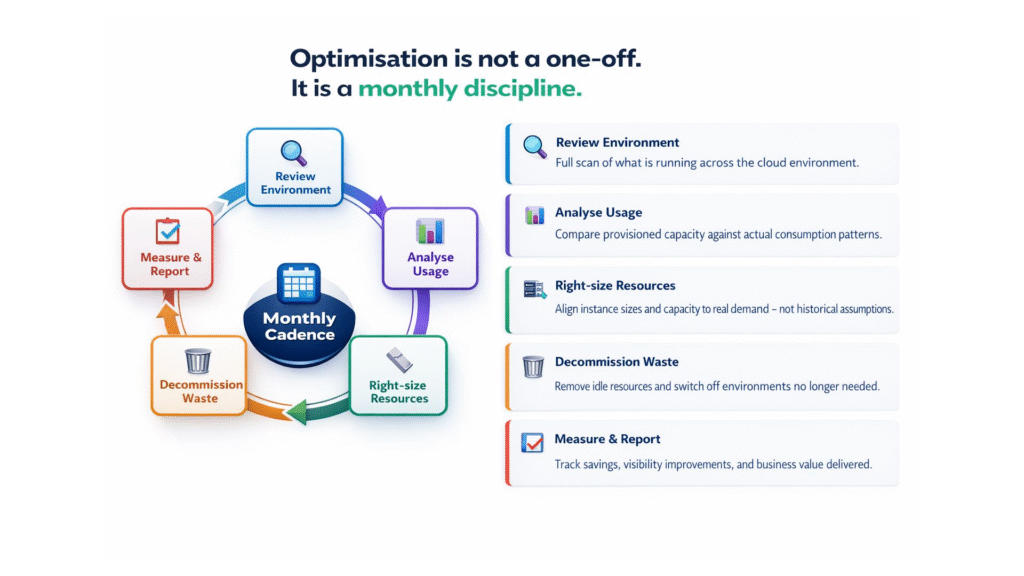
- Regular optimisation reviews across the full environment
What we found in a recent environment
In a recent environment we assessed, an organisation was running Azure and AWS in parallel, both platforms actively managed and delivering against their respective workloads. On paper, the environment looked healthy.
When we looked across the combined environment, the picture shifted. Tagging conventions were inconsistent between platforms. Cost allocation was fragmented. A significant portion of monthly spend had no clear owner and had never been reviewed for efficiency.
After establishing unified cost ownership and running the first cross-platform optimisation review, spend reduction came in at just under 30 percent, without touching the core architecture.
Technology was not an issue. The operating model was.
The question worth asking across your platforms
If your organisation is running more than one cloud platform, ask this: Does anyone own the combined environment, not just each platform individually?
If the answer involves more than one team, a shared spreadsheet, or a quarterly review that nobody drives, the governance gap is already there. The question is only how much it costs while it remains unaddressed.
Multi-cloud delivers value when it is managed as one operating model, not several disconnected environments operating in parallel.
If multi-cloud governance feels fragmented, it may be time to reassess how the environment is owned, measured, and optimised as a whole.