
You can’t outsource accountability: the reality of managed security
Many organisations today partner with external providers for monitoring, detection, and response. On paper, this makes sense, security skill shortages are real, threats are evolving quickly, and internal teams are stretched. But there is a critical misunderstanding that quietly creates risk: outsourcing monitoring does not outsource accountability.
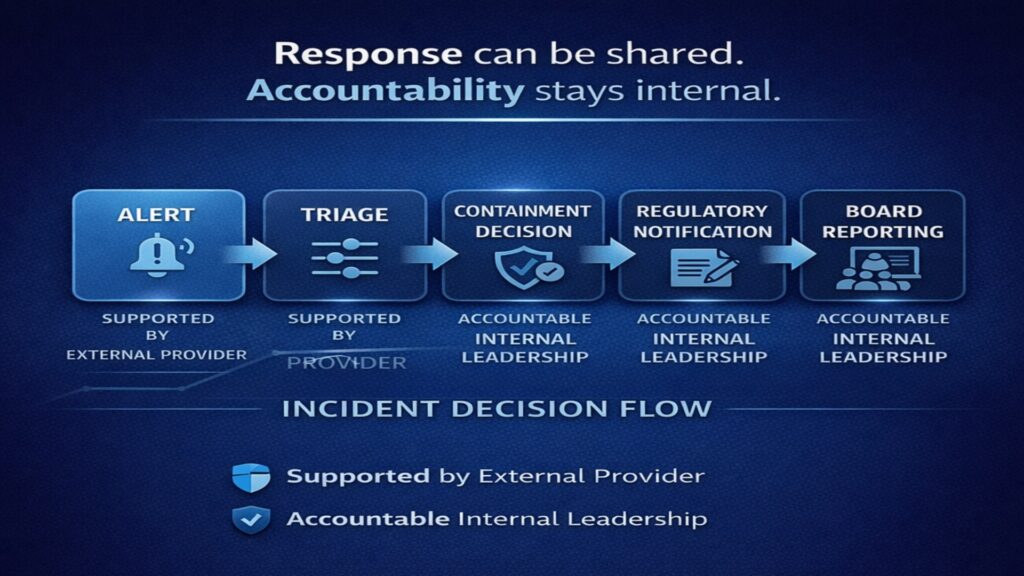
In real environments, the pattern is familiar. An organisation engages a managed security provider or SOC, monitoring improves, alerts are triaged externally, and reports arrive monthly. Everything appears structured, until an incident occurs. That’s when ambiguity surfaces: who is authorised to isolate a device, who informs executive leadership, who communicates to regulators, and who decides whether systems stay online or go offline. If these questions are not answered before an incident, response slows dramatically.
This is the accountability gap. A managed service can detect threats, investigate alerts, recommend containment steps, and execute agreed playbooks. But they cannot accept regulatory responsibility, make business-impact decisions, or own reputational risk. That remains internal. When boards ask what happened, they do not ask which vendor was monitoring logs; they ask what the organisation knew, when it knew it, and how it responded.
Where friction usually occurs is not in tooling, but in the operating model. In environments we support, gaps tend to show up in four areas:
• Escalation clarity: incidents are escalated, but internal ownership is unclear.
• Decision authority: response actions require approval, but approval chains are slow.
• Playbook alignment: provider playbooks do not fully align to business risk appetite.
• Governance rhythm: reporting exists, but strategic oversight does not.
• Escalation clarity: incidents are escalated, but internal ownership is unclear.
• Decision authority: response actions require approval, but approval chains are slow.
• Playbook alignment: provider playbooks do not fully align to business risk appetite.
• Governance rhythm: reporting exists, but strategic oversight does not.
Effective managed security looks different. The strongest environments treat the provider as an extension of internal capability, not a replacement. That means clear RACI definitions between internal teams and the provider, agreed thresholds for automated containment, defined executive escalation paths, and regular governance sessions, not just reporting. Security partnerships work best when accountability is explicit.
If you are unsure whether accountability is clear, a practical maturity test is to ask:
• Who can authorise system isolation at 2am?
• Who speaks to the board within 24 hours of a major incident?
• Who owns post-incident review and remediation funding?
• Who can authorise system isolation at 2am?
• Who speaks to the board within 24 hours of a major incident?
• Who owns post-incident review and remediation funding?
If those answers are vague, the risk is structural.
At BluBiz, we see managed security work best when it is integrated into a broader operational model that includes networking, identity, endpoint, and governance. Security does not sit in isolation; it operates across systems and decision layers. That is why accountability must be designed, not assumed.
If you are reviewing your managed security model, do not start with tooling. Start with ownership clarity. Because security can be supported. It cannot be abdicated.