
Most Cloud Migrations Succeed Technically. Very Few Succeed Operationally.
The difference between moving and improving
Workloads migrate. Complexity follows. Somewhere between the go-live celebration and the first quarterly cloud bill, the organisation realises that moving to the cloud and improving how it operates are not the same thing.
Most migrations are technically successful. The systems run. The infrastructure is in place. What is often missing is the roadmap that determines whether the investment delivers lasting value or simply relocates existing inefficiencies.
Where migrations quietly lose momentum
The complexity in cloud migration rarely comes from the technology. It comes from what was not understood before the migration began:
- Applications are moved before dependencies are fully mapped
- Security and governance controls are applied inconsistently
- Operational requirements differ from on-premises assumptions
- Costs increase before value is realised
Each of these is solvable. But they are far easier to address in the planning phase than after workloads are already running in production.
What leadership expects from migration investment
Cloud migration carries a meaningful budget commitment. Leadership expects that investment to deliver tangible improvement, not just a different hosting bill.
The question boards ask is simple: are we more agile, more efficient, and better positioned than we were before? A migration without a clear roadmap makes that question difficult to answer with confidence.
What a structured roadmap actually looks like
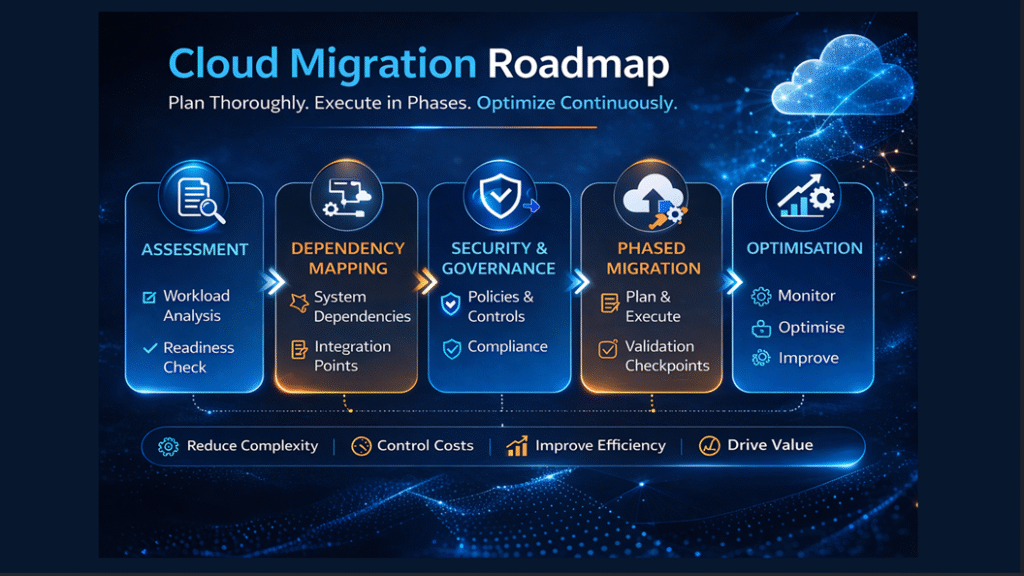
A migration roadmap is not just a Gantt chart. It is a sequenced plan built on clear foundations: workload assessment, dependency mapping, defined security and governance controls, and phased execution with validation at each stage.
Phasing matters. Migrating everything at once concentrates on risk. Moving workloads in logical groups — with checkpoints to validate performance, cost, and security — gives teams the ability to course-correct before problems compound.
What we see when we look closely
A pattern we see consistently when reviewing cloud environments: a mid-size organisation migrates to its core business applications over six to twelve months. The migration is complete on schedule. But twelve months later, the environment is carrying duplicate resources, inconsistent security controls, and workloads with no clear owner, because dependency mapping was skipped in favour of speed.
Through structured migration planning and environment reviews, we regularly identify opportunities to simplify architectures, consolidate resources, and eliminate overheads that accumulate during unstructured migration. In several environments, addressing these gaps improved operational efficiency by up to 25 percent and reduced the ongoing management burden on internal teams.
The cloud was the right decision. The roadmap was what was missing, and what made the difference once it was in place.
A useful question before the next workload moves
Before the next application migrates, ask: do we have full visibility of what it depends on, how it will be secured, and what success looks like six months after go-live?
If the answer is uncertain, the roadmap conversation is worth having before the migration begins. The cost of that conversation is minimal. The cost of skipping tends to show up later, and stay for a while.
If migration outcomes are not delivering the expected improvement, it may be time to reassess the roadmap and how it aligns to operational goals.