
/
Hybrid Cloud Strategy Explained
/
Hybrid cloud is often described as a technology model, but in reality it is an architectural decision about how an organisation operates.
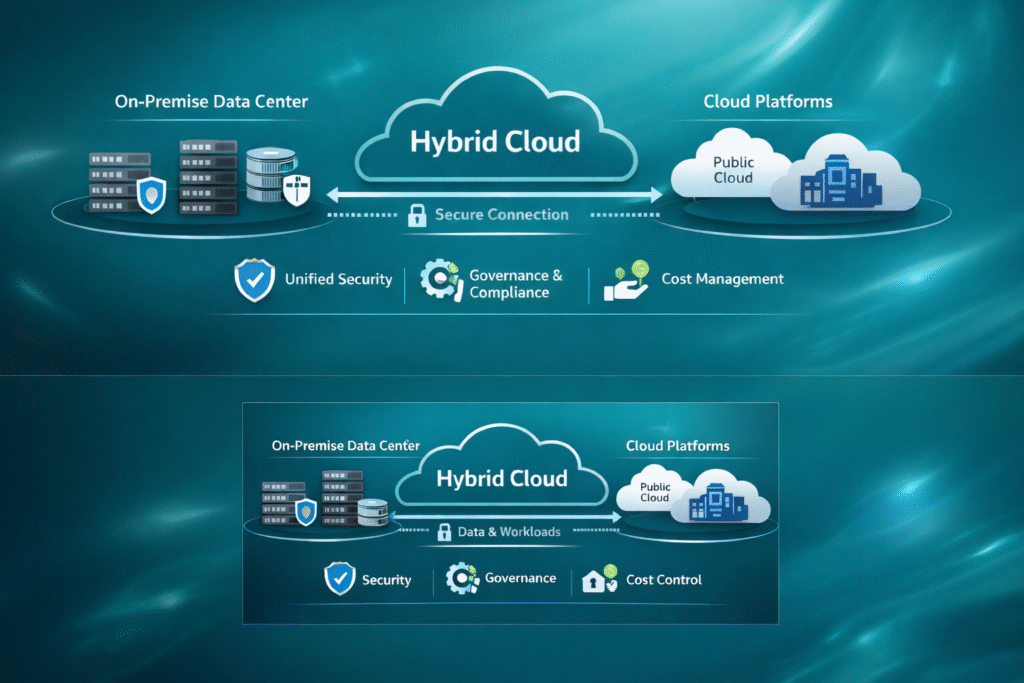
Hybrid cloud environments combine on-premises infrastructure with cloud platforms to support different business, security, and operational requirements. A hybrid cloud strategy defines how those environments are governed, secured, and aligned to performance, risk, and growth objectives.
Many organisations adopt hybrid environments to gain flexibility. Systems are distributed across on-premises infrastructure and cloud platforms to support different performance, compliance, and scalability requirements.
However, without a clear strategy, hybrid environments can quickly become complex. Systems evolve independently, ownership becomes unclear, and security practices vary between environments.
The result is an architecture that grows in complexity faster than the value it delivers.
Where hybrid strategies often break down
Hybrid environments frequently develop organically rather than intentionally.
Cloud services may be introduced quickly to support new initiatives, while legacy systems remain on premises for compatibility. Over time, this creates fragmented environments where governance, security, and cost oversight are inconsistent.
Common signs of a weak hybrid strategy include:
- Unclear workload ownership
- Inconsistent security standards
- Limited operational visibility across environments
- Cloud consumption without clear financial accountability
When these patterns emerge, hybrid infrastructure becomes difficult to manage, secure, and optimise.
What a hybrid cloud strategy should define
A sustainable hybrid environment requires more than connecting cloud platforms to existing infrastructure.
Effective hybrid strategies typically focus on four core areas:
- Intentional workload placement
Workloads should be placed where they perform best based on performance, data sensitivity, integration requirements, and cost.
- Unified governance
Operational policies should apply consistently across cloud and on-premises systems.
- Consistent security architecture
Identity, monitoring, and protection controls must operate across the entire environment rather than separately in each platform.
- Financial accountability
Cloud flexibility must be supported by cost governance so that infrastructure consumption aligns with business value.
The BluBiz perspective
In many environments we assess, organisations already have the technology required to operate hybrid environments successfully.
The challenge is rarely the tools themselves. It is the absence of a clear architectural strategy that connects technology decisions to business objectives.
When hybrid environments are designed around capability and governance, they become far easier to manage, secure, and scale.
A practical perspective
If your hybrid environment has grown organically rather than intentionally, the next step is not necessarily more technology. It is a clear architectural review, one that maps workload placement, governance gaps, security consistency, and cost accountability across your environment.
The organisations that get the most from hybrid cloud are the ones that treat it as a strategic operating model, not a collection of connected systems.